


The Roastery & Cafe
Mon-Fri: 7-5
Sat-Sun: 8-4
Night Swim Coffee
Couldn't load pickup availability
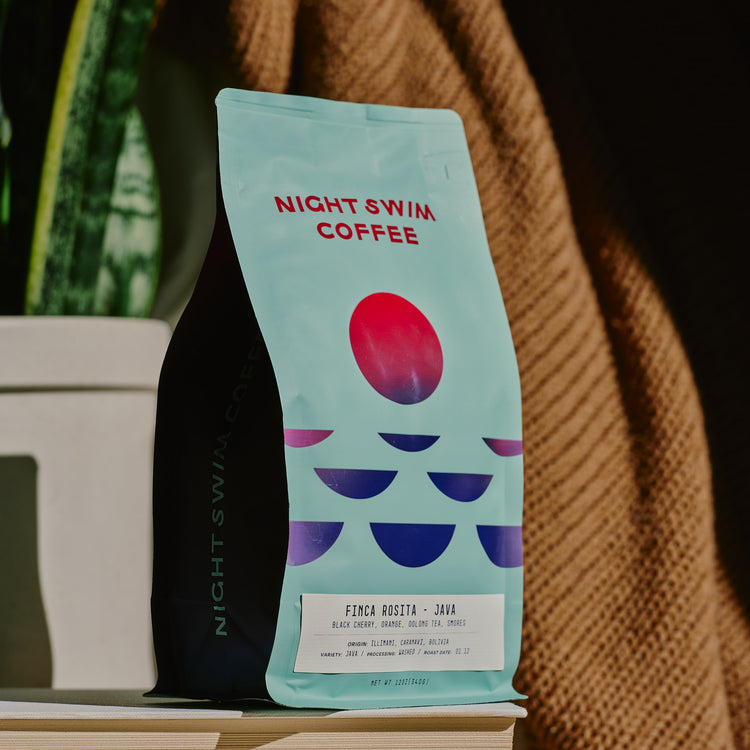
PRODUCER: Finca Rosita
LOCATION: Illimani, Caranavi, Bolivia
ELEVATION: 1350-1740 MASL
VARIETY: Java
PROCESSING: Washed
We Taste: Black Cherry, Orange, Oolong Tea, S’mores
Finca Rosita is located in the Illimani community in the gorgeous region of Caranavi, Bolivia. The farm covers 32 hectares, solely dedicated to coffee cultivation. Finca Rosita grows a variety of coffee varieties, including Java, Catuai, Geisha, Typica, and Pink Bourbon, all carefully tended under ideal conditions provided by the farm and its microclimate.
The farm is named in honor of the memory of the matriarch of the Valverde-Aramayo family, Rosa Angelica Aramayo.
The vegetation changes rapidly, from large plantations of potatoes and quinoa to many hectares of coffee, plantain, yucca and others. These and other peculiarities of the Andean terrain create the complexity and differentiation of the Bolivian coffee.
Caranavi became known for coffee production in the 1960’s, following Bolivia’s agricultural reform, and coffee exporting peaked in the 1990’s with heavy investment and interest from the private sector. Throughout the 90’s, coffee production was focused on volume over quality.
In the early aughts, significant investments were made by international development agencies, including the United States Agency for International Development (USAID), to focus on the production of quality coffee as an alternative to coca production. Funds were directed toward coffee infrastructure such as processing plants, producers received training on Good Agricultural Practices, and coffee production became much more technified and developed. Most of these agencies are no longer operating in Caranavi, although the German development agency GIZ and some Northern European non-profit agencies and foundations continue to work with coffee producers.
More recently, the Municipality of Caranavi and Bolivia’s central government have invested to incentivize coffee production through coffee quality competitions, and the Ministry of Rural Development also had a seedling program, referred to as “El Programa,” which sold coffee seedlings at heavily subsidized rates to encourage coffee production.
Over the past 15 years, coffee has become a big part of Caranavi's identity and culture. The main structure in the town square reads “Province of Caranavi: Bolivian Coffee Capital,” and there are coffee shops everywhere. There are also frequent coffee events and competitions. People are proud of being coffee farmers and they are very competitive about who has the best coffee. A new, younger generation is getting involved, and the outlook for Bolivian coffee production is promising. Some older producers have handed their farms over to the next generation, and many producers are in their 30’s and early 40s.

Mon-Fri: 7-5
Sat-Sun: 8-4
Mon-Fri: 7-7
Sat-Sun: 8-6
Mon-Fri: 7-5
Sat-Sun: 8-5
Mon-Fri: 7-6
Sat-Sun: Closed
Mon-Fri: 7-3
Sat-Sun: Closed
Mon-Fri: 7-5
Sat 8-6
Sun 8-5
Mon-Fri: 7-3
Sat - Sun 8-4


